Artikler
HARPIA: A new layer of defence against aerial threats
arrow_backTil oversigten9. juli 2026 | EVPU Defence
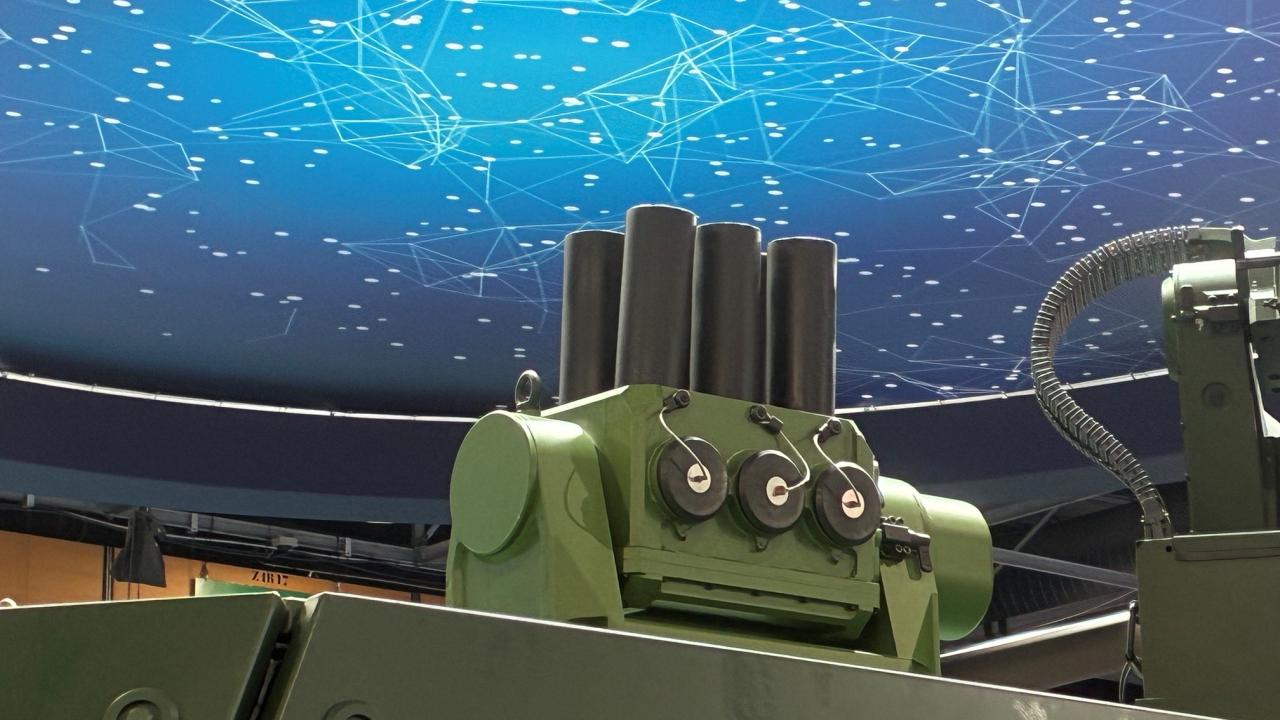
The rapid proliferation of unmanned aerial systems has reshaped the modern battlefield. Low-cost drones, loitering munitions, and increasingly sophisticated top-attack weapons have become ubiquitous and capable of striking high-value assets with unprecedented precision. In this environment, counter-unmanned aerial systems (C-UAS) represent core elements of force protection, tasked with preserving combat power and safeguarding crews against threats that can emerge with little warning from any direction.
Within this evolving threat landscape, C-UAS systems no longer operate in isolation. They form part of a layered defensive architecture that combines electronic warfare, kinetic interceptors, passive protection, and networked command-and-control. Hard-kill solutions, in particular, have gained renewed relevance as adversaries adopt autonomous drones and encrypted datalinks that are less susceptible to jamming alone. It is in this context that the HARPIA system positions itself: not as a standalone counter-drone device, but as an integrated protection capability designed to operate alongside other battlefield systems, enhancing survivability at the platform and formation level.
Thanks to its advanced detection capabilities and use of artificial intelligence elements, C-UAS HARPIA can detect and respond to threats automatically and almost instantly, easing the burden on the vehicle crew. Its design philosophy reflects the realities of contemporary combat, where threats such as advanced loitering munition and anti-tank guided missiles can appear suddenly, attack from complex trajectories, and overwhelm unprotected platforms. HARPIA addresses this challenge by providing an autonomous, reactive shield that can be mounted on a wide spectrum of platforms, from light logistical vehicles operating in rear areas to heavy armoured combat vehicles at the forward edge of the battle area.
HARPIA relies on a mix of radar and electro-optical sensors, working together to detect and track threats in the air. This enables the system to detect, classify, and track fast-moving aerial across the battlefield and electronic warfare environment. Once a threat is identified, HARPIA automatically assesses its trajectory, selecting the optimal moment and method of engagement without requiring direct operator intervention. This level of automation is critical in saturation scenarios, where reaction times are measured in fractions of a second and human decision-making alone may be insufficient.
The engagement mechanism itself is designed with both effectiveness and restraint in mind. The system’s narrow engagement zone is a defining characteristic, intended to minimise collateral damage and reduce risk to nearby friendly forces or civilian infrastructure. This is particularly relevant in dense operational environments, where armoured units may be operating in close proximity to dismounted troops or within urban terrain.
Sensor data received from HARPIA and processed by the vehicle’s onboard systems can be shared across the formation through a higher-level C2 system, providing real-time situational awareness not only to the protected crew but to adjacent units and command elements. In practice, this means that the detection of a drone or missile threat by one platform can inform the positioning and readiness of others, supporting coordinated responses and reinforcing the principle of collective protection.
In sum, C-UAS HARPIA reflects a shift in how vehicle protection is conceived in the age of pervasive aerial threats. As drone-based weapons and precision-guided munitions continue to proliferate, systems such as HARPIA are likely to become integral components of armoured platforms.


Artikel er skrevet af:
EVPU Defence
EVPU Defence er specialiseret i kundetilpassede forsvars- og sikkerhedsløsninger, herunder elektrooptiske systemer, fjernbetjente våbenstationer, C-UAS-løsninger, sigter til vognkommandører og skytter, laser- og radarsikringssystemer samt termiske kameraer og dagslyskameraer. Virksomheden blev grundlagt i 2001 og er certificeret i henhold til ISO 9001 og AQAP 2110.
Se profil