Artikler
From idea to the operator’s hand – the story behind the new CV90 gunner control
arrow_backTil oversigten7. august 2026 | Electrum Automation AB
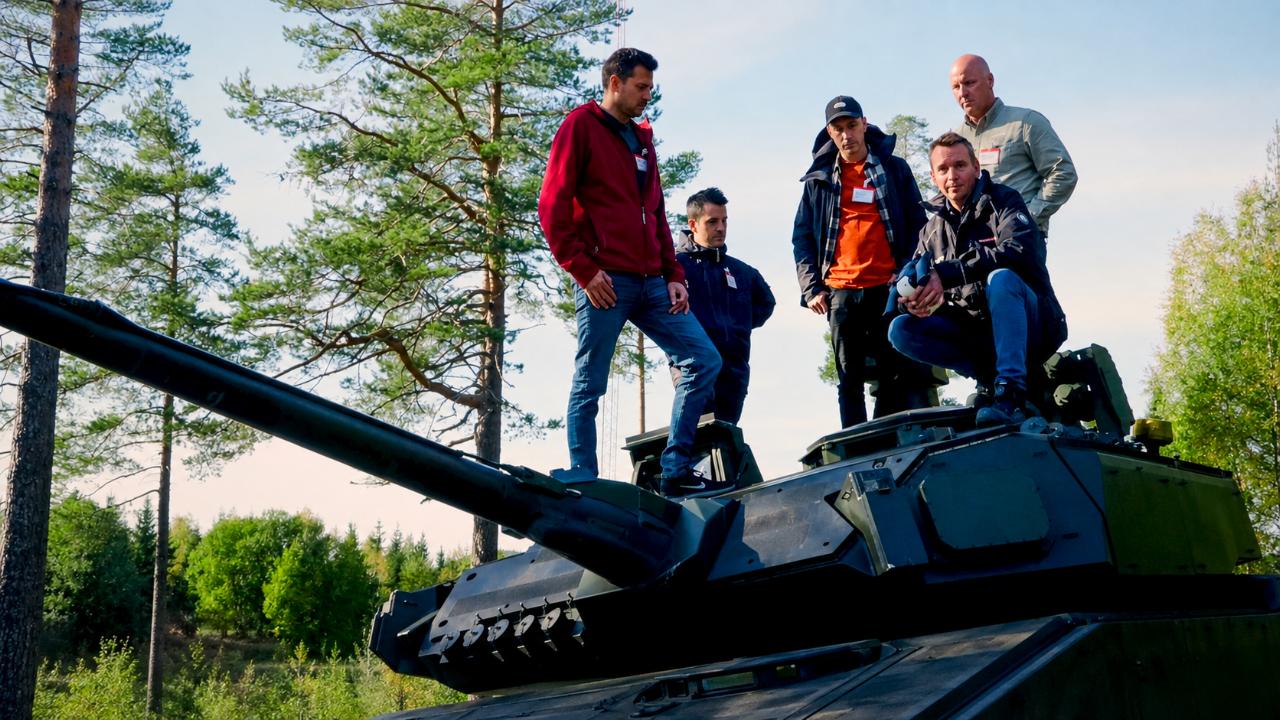
A control handle is a small component in a 30-plus-tonne combat vehicle. But for the gunner, it is one of the most important.
It is the physical connection between human and weapon system – and when BAE Systems Hägglunds began looking for a new generation of gunner control for the CV90, the task eventually landed about 100 kilometres north of Örnsköldsvik, at Electrum Automation in Umeå.
What followed was not a conventional build-to-print assignment. It became a joint development project involving ergonomics, industrial design, electronics, mechanics, manufacturing and, perhaps most importantly, people from both organisations working closely together.
It started with a challenge
The existing solution had done its job, but BAE Systems Hägglunds was looking for something designed for the next generation of the CV90.
The new control needed modern electronics and high reliability for a critical application. But BAE Hägglunds was also looking beyond the immediate specification.
The handle needed to be ergonomic and intuitive for the operator while offering enough flexibility to accommodate functions and requirements that might emerge later in the life of the vehicle.
That is not a trivial combination.
Military vehicles remain in service for decades. The mechanical design must survive a demanding environment, the electronics must be dependable, and the Human Machine Interface must work for the person using it – often under conditions where there is little room for hesitation or error.
For Electrum, that made the assignment particularly interesting.
Thomas Moström, then responsible for design at Electrum, remembers the project as one where the requirements forced the company to raise the bar.
BAE Systems Hägglunds did not come to Electrum simply looking for someone to manufacture a predefined product. They wanted an engineering partner capable of contributing to the solution.
That changed the nature of the project from the start.
Designing around the person in the vehicle
BAE Systems describes the CV90 philosophy as soldier-centric: adapting the machine around the human rather than asking the human to adapt to the machine.
A gunner control is perhaps one of the clearest examples of that philosophy.
Dimensions can be defined in CAD and electrical characteristics can be measured on a test bench. But whether a control actually feels right in the hand is a different question.
The position of the controls, the shape of the handle and the way different functions can be accessed all affect how naturally the gunner can interact with the vehicle.
This meant that development became an iterative process between the teams.
Ideas became designs, designs became physical solutions and those solutions could be evaluated and refined. Electronics, mechanics and ergonomics developed together rather than being treated as separate parts of the product.
For a relatively small engineering company such as Electrum, working directly with the specialists at BAE Systems Hägglunds was also a learning process.
The requirements were demanding – but that was part of the attraction.
“The defence industry places extremely high demands on its suppliers. Meeting those demands has developed us as a company as well,” says Thomas Moström.
More than solving today’s requirement
One aspect of the resulting design was particularly important to BAE Systems Hägglunds: it should not be locked to today's requirements.
Håkan Karlsson, then Category Manager for Weapons & Fire Control Systems at BAE Systems Hägglunds, highlighted the combination of modern electronics, innovative design and flexibility in the new solution – including its potential to accommodate functions that had not yet been fully defined.
That is an important detail.
A product developed for a platform such as the CV90 should not merely work when it leaves the factory. It needs to remain useful as the vehicle evolves.
The result was therefore not simply a new shape around existing electronics, but a control designed as a platform for continued development.
Then came the difficult part: making it for real
There is a big difference between demonstrating a good prototype and producing a product repeatedly to the same standard.
Once the design had been established, attention shifted towards industrialisation.
Electrum’s advantage was that development and production could work closely together in Umeå. Issues discovered when assembling or testing early units could quickly find their way back to the engineers.
The people who were ultimately going to manufacture the product therefore became part of making the design manufacturable.
That interaction is easily overlooked in product development. A beautiful CAD model is of little value if it cannot be efficiently assembled, tested, documented and supported year after year.
And in this case, “year after year” has a very literal meaning.
The agreement includes responsibility for repairs and spare parts for 30 years.
That puts component selection, documentation, traceability and maintainability into a very different perspective.
The project consequently affected more than the product itself. The demands from BAE Systems Hägglunds helped Electrum develop its processes for quality management and high-reliability products – experience that has since spread into other projects and other customers.
When one development project becomes a foundation for the next
There is also an interesting second chapter to the story.
A few years later, BAE Systems Hägglunds needed another Human Machine Interface for the CV90 – this time a new driver handle for upcoming vehicle programmes.
Again, Electrum was selected as development partner.
When three completely new concepts were developed for the driver control, experience and design elements from the gunner control were deliberately carried forward.
The first project had therefore created something beyond the product itself: knowledge, design principles and, importantly, a working relationship between the two companies.
That may ultimately be one of the more interesting lessons from the project.
Defence innovation is often associated with large systems, advanced weapons and breakthrough technologies. But innovation also happens on a much smaller scale – between engineers discussing a detail, a prototype being passed from one hand to another, or a production technician finding a better way to build something.
And eventually all those decisions end up in one place:
in the operator’s hand.
Put your hand on the real thing at DALO Industry Days
At DALO Industry Days 2026, the story does not have to end with photographs or a product in a display case.
Electrum is bringing a shooting simulator equipped with the real CV90 gunner control.
Visitors can take the operator’s position, experience the handle and its controls for themselves – and find out whether good engineering also improves their chances of setting the exhibition high score.
The same type of control that started as drawings, prototypes and discussions between engineers in northern Sweden can now be experienced first-hand in Herning.
Meet Electrum Automation in Hall D, stand D3190, on 19–20 August.
And be prepared to aim carefully.


Artikel er skrevet af:
Electrum Automation AB
Electrum Automation ABs kerneforretning er systemintegration og produktudvikling, primært inden for højpålidelige maskiner til en civil og forsvarsbase, ofte inden for menneske-maskine-grænseflader.
Vi har omfattende erfaring med at udvikle mekatronik og software til CAN-baserede systemer, samt skræddersyede produkter til sikkerhedsrelateret styring og kontrol.
Vi designer og leverer komponenter eller komplette løsninger til førende producenter af maskiner og terrængående køretøjer, og vi stræber efter at være en sand innovationspartner.